
Mayberry Trading Post and the Real Mayberry Legacy
An installment in our Blue Ridge Travel series.
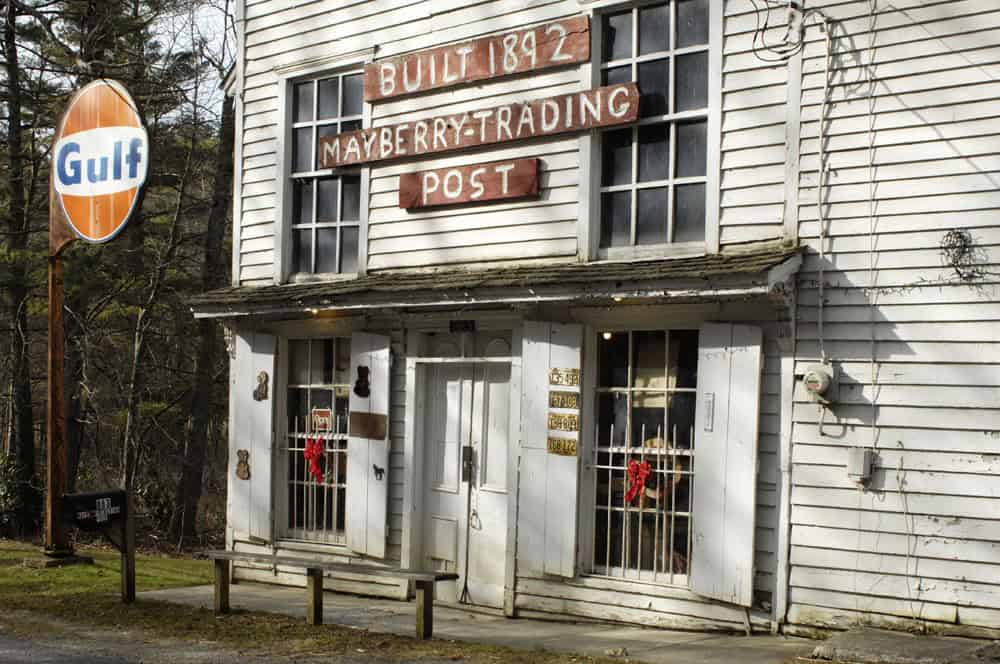
In Meadows of Dan, Virginia, the Blue Ridge Parkway passes a weathered frame building that has stood since 1892. Travelers know it as the Mayberry Trading Post. The name catches the eye because it recalls Andy Griffith’s television Mayberry, but this place is real. Its story is one of change met with perseverance, a reminder that communities in the mountains have always balanced tradition with survival.
A Creekside Community
Long before the Parkway, Mayberry Creek shaped the lives of the families who settled nearby. They cut small fields into the ridges and planted corn and rye. At harvest, neighbors turned out to help one another, the work eased by extra hands. The creek wasn’t just water for stock. By 1800 it powered gristmills, including Heffingers, remembered by early settlers.
This wasn’t a formal town, more a scattering of farms tied by kinship. Children walked to one-room schools, Sunday worship brought people together, and chores filled the rest of the week. Reaching larger towns for supplies took time, so a small store along the road became essential.
The Mayberry Trading Post filled that need. Local accounts trace the community store to the 1850s, serving both farm families and travelers along the Danville-to-Wytheville Turnpike. The present building went up in 1892, with bricks for its chimney made by Simon P. Scott. The post office operated inside until 1922. People carried home flour and salt, sometimes nails or cloth, often paid for with eggs or produce. It was here that news moved faster than the creek, passed across the counter with each exchange.
Surviving Hard Times
The Civil War strained every community. Families lost sons, food supplies thinned, and soldiers used the road when they passed through. Even then, the store stayed open. Ownership changed over time, but the Trading Post kept its doors wide, a steady presence when cash was short and barter was the only way to trade.
By the late 1800s, the Post was established, its porch worn by boots, its shelves lined with whatever staples could be found. The Depression years forced families back onto the land. Many relied on the Post for what little they could buy and what they could barter, the building itself standing as proof of endurance when times were lean.

The Parkway Arrives
The 1930s brought the most visible upheaval. The federal government began cutting a scenic road through the Blue Ridge. Meadows of Dan lay in its path. Crews blasted rock, felled timber, and bought land for rights-of-way. The Scott house, part of the Mayberry community, was torn down for the Blue Ridge Parkway. A once-quiet settlement found itself exposed to a steady stream of outsiders.
The Mayberry Trading Post had to adapt. It sold gasoline for a time, stocked items travelers wanted, and appeared in postcards and guidebooks. For locals, the Parkway meant disruption; farmland divided, homes relocated, the old turnpike fading from use. Yet for the Trading Post, the road brought new life. The same porch that once welcomed neighbors now greeted tourists from across the country.
Recorded and Remembered
Local voices made sure the history wasn’t lost. Addie Wood, who grew up nearby, wrote in 1985 about the mills on Mayberry Creek and the families who relied on them. Larry Spangler drew maps that showed how the community looked around 1915. Aaron McAlexander, whose family goes back generations in Mayberry Creek, has written a history of the Trading Post. Their work preserved memories that could have slipped away. Through their accounts, the Trading Post stands not just as a store but as a touchstone for what life here once meant.

Holding On Through Change
The 20th century brought challenges of a different sort. Supermarkets appeared in nearby towns. Highways drew traffic away from the Parkway. The small country store model was hard to keep afloat. Yet families kept the Mayberry Trading Post open, sometimes with little profit, because closing it would have meant losing a piece of the community’s past.
Owners added handmade crafts, local jams, and ice cream for Parkway travelers. Some years were busier than others, but the Post always managed to continue. Its endurance gave the building a character that newer shops couldn’t match. People who stopped felt the weight of history in the uneven floorboards and shelves that had held goods for more than a century.
The Mayberry Connection
Visitors often arrive curious about the name. Andy Griffith’s fictional Mayberry was set in North Carolina, but the echo is deliberate: Griffith’s mother was from Mayberry Creek. Griffith grew up in Mount Airy, NC, not far from Meadows of Dan, and drew inspiration from the small communities he knew. When travelers see the Mayberry Trading Post, they connect the television image with a place that has weathered real change.
It isn’t an exact parallel. Television Mayberry was written for humor and nostalgia. The store in Meadows of Dan tells a harder story, one of families facing war, poverty, and relocation, yet keeping a business alive through it all. That mix of endurance and adaptability is what ties the two together.
A Legacy Still Standing
Today Parkway travelers stop for drinks, crafts, and a look inside a building that has seen nearly 150 years of steady use. The shelves no longer carry flour or nails, but the Post still offers connection. Visitors step across worn thresholds that mark generations of use.
Television keeps Andy Griffith’s Mayberry alive on screen. To see the real Mayberry, you have to drive to a creek in Virginia and walk into a trading post that has never left.
More Blue Ridge Travel
Find more travel stories, routes, and small-town stops on the Blue Ridge Travel page.
View the Blue Ridge Travel Collection here
Enjoying Blue Ridge Tales? I hope so. If you’d like to help keep the site ad-free and the stories rolling, you can buy me a coffee.
To stay connected, subscribe to my Blue Ridge Tales newsletter, and have stories and updates delivered once a month to your inbox.


