Appalachian Work Gatherings: Sharing Mountain Labor
An installment in our Appalachian History and Culture series.

The trees were cut weeks ago and left where they fell. Oak, poplar, chestnut. Thick trunks lying crosswise in a field that needs to be planted. One man can clear brush. He can trim branches and split smaller lengths for rails. He can’t move logs that size alone.
Before noon, wagons begin to arrive along the rutted track. Men step down carrying axes, handspikes, and cant hooks. A few test the weight of a trunk, gauging leverage. Someone wedges a pole beneath the bark. Another counts off a lift. The log shifts, rolls, settles, then rolls again toward a growing pile at the edge of the field. Women carry baskets toward the shade, where food will wait until the last trunk is moved. Children drag lighter limbs into smaller stacks. No one wastes motion. The field must be ready before weather turns.
This is an Appalachian work gathering. It looks social from a distance. Up close, it is organized necessity.
What Were Appalachian Work Gatherings?
Appalachian work gatherings were cooperative labor events designed to complete tasks beyond the capacity of a single household. No wages changed hands. No written agreements were required. The understanding rested on reciprocity. You help when called. Others answer when your need rises.
These gatherings developed alongside early mountain settlement. Many families who moved into the southern Appalachians in the eighteenth century carried traditions of shared labor from the British Isles and northern Europe. Harvest bees and barn raisings were familiar responses to limited manpower and rural isolation. The mountain environment didn’t invent cooperation, but it made it indispensable.
Settlement patterns scattered families across ridges and hollows rather than concentrating them in dense towns. Travel between homes required time and effort. Hired labor was scarce and often unaffordable. Markets were distant. Under those conditions, cooperation became part of daily structure rather than occasional charity.
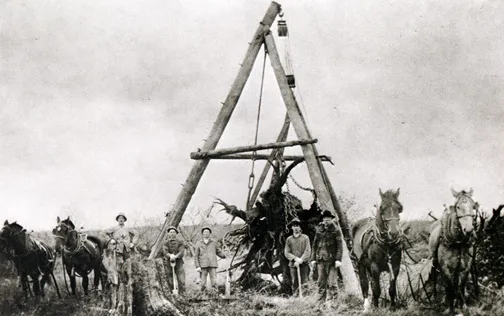
From the late eighteenth century into the early twentieth, Appalachian work gatherings provided a practical answer to geographic and economic limits. Clearing land, processing crops, raising structures, and preserving food demanded concentrated effort within narrow seasonal windows.
Why Appalachian Work Gatherings Existed
Mountain agriculture operated within tight margins. A field not cleared before frost delayed planting. Corn left too long in the stalk risked weather damage. Beans that failed to dry properly spoiled in storage. Sorghum demanded careful timing at the boil.
Even large families faced competing demands. Livestock required daily care. Fences weakened. Wood had to be cut and stacked before cold arrived. Time and labor rarely aligned neatly.
Without ready access to paid crews or machinery, neighbors formed the extended workforce. Appalachian work gatherings emerged because delays carried consequences. If a task lagged too long, hardship appeared in the pantry, the barn, and the following season.
The Social Code Behind Appalachian Work Gatherings
Participation carried expectation.
When word spread that a log rolling or bean stringing was scheduled, absence required explanation. Distance or illness excused it. Indifference didn’t. Work moved steadily. Those who strained expected others to match the pace.
Hosts provided food once visible progress had been made. A pot of beans, cornbread, preserved meat, pies carried in baskets. The meal acknowledged effort already given. Conversation relaxed only after the task was complete.
Reputation carried weight. A household known for declining invitations couldn’t assume an equal response later. No ledger recorded these exchanges, yet memory filled that role. Communities understood who contributed and who didn’t.
The expectation to participate created order. The mechanism that sustained it ran deeper.
Reciprocity as Social Infrastructure
Reciprocity did more than encourage cooperation. It reduced risk across entire communities.
In isolated mountain settlements, formal institutions were limited. Banks were distant. Insurance was rare. Credit could be difficult to secure. A failed crop, an injured worker, or a delayed harvest could threaten stability.
Appalachian work gatherings functioned as a distributed labor system. Instead of hiring help with cash that many families didn’t have, households invested effort into one another. Each gathering represented a contribution to a shared reserve of labor.
The return wasn’t immediate, but it was expected.
When a barn needed raising, when corn had to be cut before frost, or when illness left a household short-handed, prior participation carried influence. Neighbors responded because the arrangement depended on continuity.
This structure also circulated knowledge. Techniques for clearing timber, preserving food, or managing crops moved across households through repeated shared effort. Skill didn’t remain isolated. It spread.
Reciprocity created accountability without formal enforcement. Memory served as record. Reputation functioned as currency. Participation built standing within the community.
In difficult terrain with limited outside support, this informal infrastructure proved durable. It allowed small settlements to absorb setbacks that might otherwise have overwhelmed a single household.
Types of Appalachian Work Gatherings
Within that framework, different needs shaped distinct forms of gathering.
Log Rollings

Log rollings assembled neighbors to clear newly cut ground. Using leverage and coordinated movement, crews rolled heavy trunks into piles for burning or future use. The labor demanded strength and timing. This will be explored in a dedicated article.
Pea Thrashings
After field peas dried, families gathered to separate seed from hull. Canvas sheets were spread. Sticks rose and struck in steady rhythm. Speed reduced risk from weather or moisture. This will be explored in a dedicated article.
Bean Stringings
Green beans intended for winter storage were threaded into long strands, often called leather britches, and hung to dry. Porches filled with hands at work and conversation carried at a measured pace. This will be explored in a dedicated article.
Candy Pulls
Sorghum or maple syrup, boiled to a precise stage, was poured and stretched into taffy. The process required attention and timing. Once the batch set properly, the mood eased. This will be explored in a dedicated article.
Corn Shuckings

Corn shucking brought neighbors together after harvest to strip ears before storage. Rows of workers pulled back dry husks while conversation moved down the line. Traditions such as the red ear added a playful element to an otherwise repetitive task. This will be explored in a dedicated article.
Quilting Bees

During colder months when fieldwork slowed, women gathered to stitch quilts needed for households across the community. Large quilt frames allowed several people to work at once. Conversation moved as steadily as the needlework. Quilting bees combined practical labor with social support and will be explored in a dedicated article.
Music and Courtship Within the Gathering
Music didn’t replace labor. It followed completion.
Once the field was cleared or the beans hung in rows, someone might bring out a fiddle. A banjo might answer. Younger members observed and learned without formal instruction. Practical knowledge moved the same way, through proximity and repetition.
These gatherings also created space for courtship. Young men and women met within extended family networks yet with room for conversation. Relationships formed inside known circles.
The social dimension rested on the task itself. Without the labor, there was no reason to assemble.
What Changed When Machines Arrived
Mechanization gradually reduced reliance on large-scale Appalachian work gatherings. Chainsaws replaced teams clearing timber. Tractors uprooted stumps that once required coordinated strength. Commercial canning and refrigeration eased the urgency of communal preservation.

Improved roads and expanding wage labor altered time itself. As more residents worked outside the farm, seasonal cooperation lost some of its necessity.
The gatherings didn’t disappear immediately. In some areas, they continued into the mid-twentieth century. Over time, however, their practical function diminished.

Some elements survive in demonstrations or heritage events. Others remain in memory, described by those who recall fields filling with neighbors focused on a shared objective.
Machines made the work easier, but they also removed the reason for neighbors to gather.
Why Appalachian Work Gatherings Still Matter
Return to the field with stacked logs and unsettled sky.
Today, engines shoulder much of the heavy lifting. Equipment accomplishes in hours what once demanded coordinated human effort. Yet the principle behind Appalachian work gatherings remains recognizable.
When floodwater rises or a barn roof tears loose in the wind, neighbors still arrive with tools in hand. Not from sentiment. From practicality.
Appalachian work gatherings were systems built to manage risk and complete urgent work in difficult terrain. The tools changed. The conditions shifted. The instinct to meet pressure with cooperation endured.
More Appalachian History & Culture
Find more stories from the region’s past on the History and Culture page.
Appalachian History and Culture Collection
Enjoying Blue Ridge Tales? I hope so. If you’d like to help keep the site ad-free and the stories rolling, you can buy me a coffee.
To stay connected, subscribe to my Blue Ridge Tales newsletter, and have stories and updates delivered once a month to your inbox.